
We’ve explored a few Jewish mourning and funeral traditions in blogs past. Join us in a continuation of exploring graveside Jewish burial practices and traditions.
One of the most beautiful parts of Jewish burial tradition is the firm belief in acknowledging death has occurred. This belief is instilled from the position that it is only when we acknowledge our pain and sorrow that healing can begin.

Aninut, which in Hebrew translates to mean “deep sorrow” is the time between when a person dies and when they are buried. The Aninut recognizes that grief is often all-consuming, so it’s a time where Jews tend to their deceased, make arrangements, and put other obligations on hold-–it’s a time to drink water, take deep breaths, and practice being easy with the self. The Aninut is a beautiful reminder to slow down in times of great grief because so much of our modern world does not build in time for mourning. For those who practice Judaism this tradition gives permission to allow oneself to turn away from the overwhelming duties of the day to day grind and allow themselves to lament the passing of someone they deeply loved.
Historically, Jewish law dictates that burial must take place as soon as possible. According to the Talmud, a central text of Rabbinic teachings, this practice was ordained by Joshua–the leader of the Israelites after Moses died—after the conquest of Canaan. Jews continue this funeral tradition in our modern contexts as embalming is usually forbidden by Jewish law, so many decide to bury their loved one within 24hrs of the time of death.
In addition to the Aninut, there are other rituals involved in the Jewish burial process. Recitations of prayers, for instance. Upon hearing the news a loved one has passed many religious Jews recite the words “barukh dayan ha-emet” (“blessed is the true judge”) in one. Mourner’s often tear their clothes (or a ribbon). The tearing of these garments symbolize that the person will never be the same after experiencing such a loss. Another funeral ritual we explored in our last blog is the process of how the dead are washed and cared for by the holy society of chevra kadisha.
Any specific arrangements of Jewish funerals vary from region to region and community to community. However, one tradition which is followed by most Jews (and that Jewish law dictates) is that everyone, be they rich or poor, is buried in a plain and simple fashion: a pine box casket or a burial shroud. This ensures everyone the same amount of dignity and respect in death.
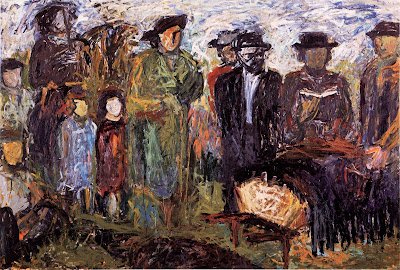
Jewish funeral services may be held in a synagogue, a funeral home, or in many cases at the graveside. They usually include the recitation of the prayer “El Maleh Rahamim” (God full of compassion), as well as a reading of psalms, and a eulogy. It is tradition that once the service is complete and the body is placed inside the grave, each mourner will take turns shoveling or placing a handful of dirt directly onto the grave. One custom calls for mourners to place the soil in with the shovel turned upside down to honor the reluctance of saying goodbye to their loved one. Whatever the specific ritual, the communal participation of grieving loved ones is crucial to the final act of care, kindness, and respect shown to the dead (kevod ha-met), and often serves as an act of healing for those in the deepest throes of grief.
According to the Talmud, flowers are not to be used in the funeral or placed on the grave as “whatever belongs to the dead and his grave may not be used for the benefit of the living.” Oftentimes, upon future visits to the grave people will often leave tiny stones to pay their respects and let others know someone has been by to visit. At Larkspur we ask families to place a small rock on top of the grave at the end of the service from those in the soil instead of bringing rocks each time they visit so as to not disturb the existing ecosystem. After the graveside service is complete, bereaved family members proceed first as other funeral participants form two lines on either side of them to walk through; this way the bereaved can receive words of comfort and compassion as they leave the cemetery.
If you are interested in learning more about traditional Jewish burial practices or how Larkspur can be a place where meaningful rituals like this can take place, please contact us. We would love to discuss the ways in which natural burial practices can feel significant and healing for you and your loved ones.